- Nerd Out on Business
- Posts
- The Power of Software + Payments
The Power of Software + Payments
Toast’s model combines software subscription stability with payments-driven growth. The upside is clear, but gross margin ceilings and fierce competition mean Toast’s moat is solid but not unbreakable.

Nick Horob
September 14, 2025
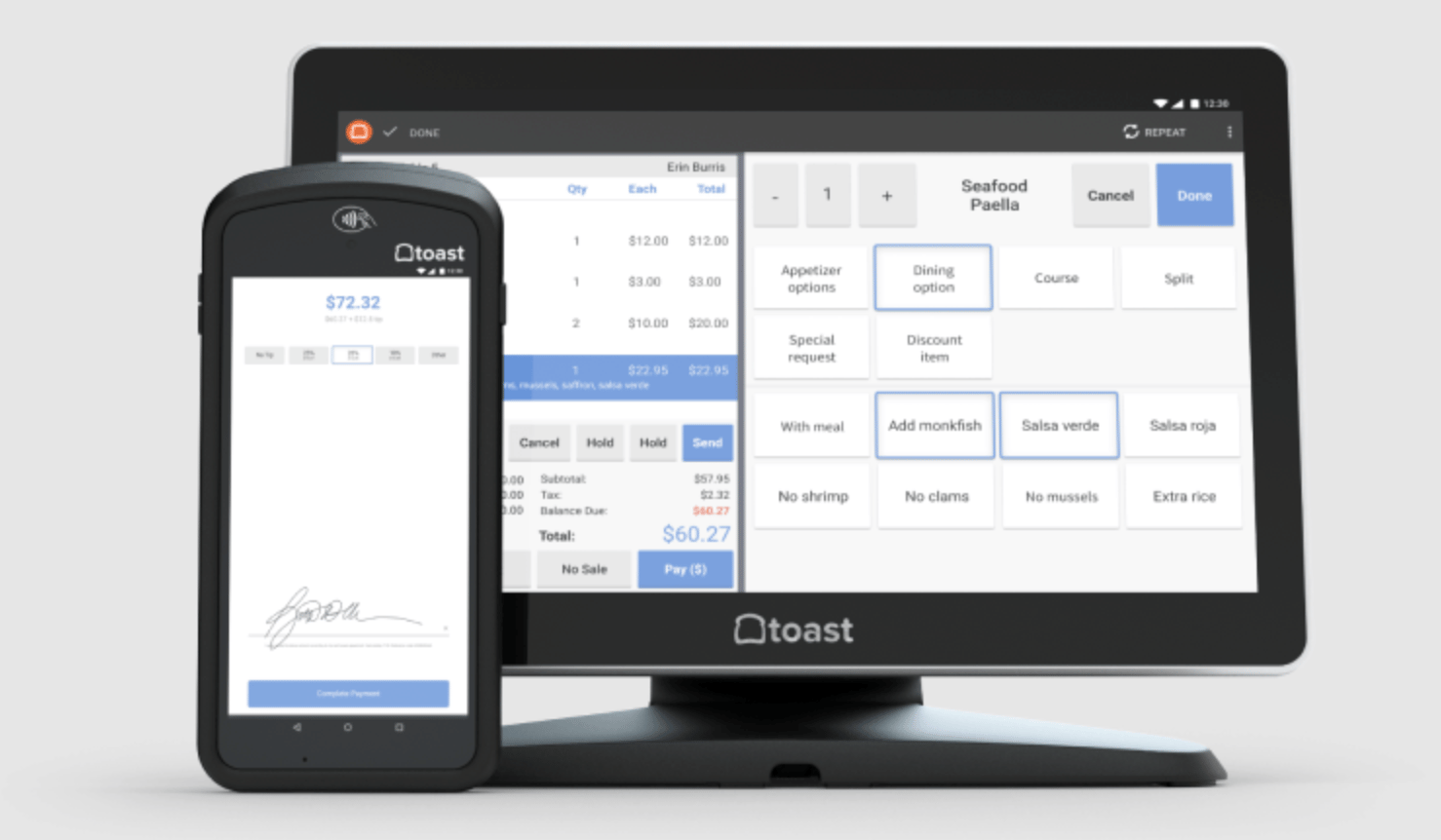
Today, I'm looking at Toast, the restaurant software and payments company. They’ve built a vertical operating system for restaurants that combines point-of-sale, payments, hardware, and add-ons like online ordering and payroll.
This report is especially valuable for me as I'm working on building myself my own personal ERP. If I can make it awesome, it's likely something that I will sell, and an integral part of a ERP is an accounting platform. One of the things that I really liked about QuickBooks Online is the ability to send somebody an invoice and then they would facilitate the payment for me.
It's common that there's margin available to the company that's facilitating the payments, and that is something that literally grows with a business in a way that tends to feel pretty good for the person using the software. But what QuickBooks Online has been doing is growing their revenue from payments while also pushing their pricing higher and higher. There's time for a market entrant, in my opinion.
So all in all, software meeting payments is something that I'm going to be spending quite a bit of my personal time on.
A few things stand out:
Revenue mix: ~82% of Toast’s FY2024 revenue came from payments. That fuels growth but drags gross margins compared to pure software.
Profit turn: FY2024 was their first GAAP-profitable year. TTM numbers show operating leverage finally kicking in.
Sticky product: Restaurants run their daily workflows through Toast, which makes switching painful.
Bumps in the road: In 2023 they tried adding a $0.99 consumer fee on online orders—customers revolted, and Toast had to reverse course in days. A reminder that pricing missteps can backfire fast.
This is a case study in owning the transaction flow and layering on upsells. But it also shows the risks of leaning too heavily on payment processing when margins matter.
With that, I'll see you tomorrow.
Nick
TL;DR
Toast is a vertical operating system for restaurants that bundles POS, payments, hardware, and add-ons like online ordering, payroll, and lending.
The model is simple: land the workflow where money moves, then monetize through payment volume and attach higher-margin software over time.
Payments drive the majority of revenue, which makes growth fast and sticky, but blends down gross margins versus pure SaaS.
FY2024 was the first GAAP-profitable year, and TTM results show improving operating leverage on rising scale.
Playbook for founders: own the transaction node, sequence upsells around real pain, and avoid fees that damage your customer’s customer relationship.
The 30,000-Foot View
What it does and business model: Restaurant-focused software and hardware with integrated payments. Revenue comes from subscription software, fintech take-rate on gross payment volume, and hardware and professional services.
Revenue mix, FY2024: Financial technology solutions 81.7%, subscription 14.2%, hardware and professional services 4.1%.
Key stats
Market cap: ~$23.3B as of September 10, 2025.
TTM revenue: ~$5.53B. TTM gross margin: ~25.2%. TTM net income: ~$225M.
Employees: ~5,700 at December 31, 2024.
Industry: Vertical software and payments for restaurants.
Company History
2012: Founded in Boston by Aman Narang, Steve Fredette, and Jon Grimm.
2015 to 2019: Scaled cloud POS and payments across SMB restaurants, built a module lineup that included online ordering, loyalty, and gift cards.
March 2020: Launched Rally for Restaurants to support takeout and gift cards during COVID, partnering with large consumer brands and marketplaces.
September 2021: IPO on NYSE, ticker TOST.
July 2023: Backtracked on a $0.99 consumer order fee after customer backlash, sharpening pricing discipline.
February 2024: Roughly 550 layoffs to streamline operating expense and prioritize profitable growth.
FY2024: First GAAP-profitable year.
2025: Wins Applebee’s and partners with American Express, expands internationally, and ships Toast Go 3 with intelligence features branded as ToastIQ.
Show Me the Money
Stand-out financial features
Payments-heavy mix: fintech solutions were 81.7% of FY2024 revenue, which accelerates scale but blends down gross margin relative to pure software.
Recurring engine: ARR of roughly ~$1.6B at FY2024 and roughly ~$1.9B by Q2 2025 underpins visibility and pricing experiments.
Profit inflection: FY2024 delivered first GAAP profit. TTM operating income expanded further, showing operating leverage.
Financial Data
Metric | FY2022 | FY2023 | FY2024 | TTM |
|---|---|---|---|---|
Revenue | $2,731M | $3,865M | $4,960M | $5,530M |
Gross Profit | $511M | $834M | $1,190M | $1,393M |
Gross Margin | 18.7% | 21.6% | 24.0% | 25.2% |
Ops Profit | ($384M) | ($287M) | $16M | $189M |
Ops Margin | (14.1%) | (7.4%) | 0.3% | 3.4% |
CapEx | $33M | $42M | $54M | $50M |
Net Debt | ($547M) | ($605M) | ($903M) | ($1,194M) |
The N.O.O.B. Nine — Competitive Powers
The Nerd Out on Business Nine is made up of Hamliton Helmer's famous "7 Powers" of competitive advantage (Scale Economies, Network Economies, Counter-Positioning, Switching Costs, Branding, Cornered Resource, and Process Power) combined with two of my own (Data Flywheel and Distribution Advantage).
Power | Score | Rationale |
|---|---|---|
Branding | 3/5 | Strong within restaurant SMBs, yet not dominant across all segments versus horizontal fintech brands. |
Data Flywheel | 3.5/5 | Ticket-level and GPV data inform pricing, menu engineering, lending, and marketing features. |
Process Power | 3.5/5 | Verticalized onboarding, sales specialization by segment, and module attach playbooks get better with scale. |
Scale Economies | 4/5 | Payments and support scale with location count and GPV, which improves unit economics as cohorts mature. |
Switching Costs | 4/5 | Deeply embedded in daily operations, from hardware to staff training to payment routing, which makes churn painful. |
Cornered Resource | 2/5 | No exclusive bank or network access and no unique IP choke point. |
Network Economies | 3/5 | Not a classic marketplace network, but integrations, diner reach, and data-driven features create ecosystem effects. |
Counter-Positioning | 3/5 | A full-stack POS plus fintech is hard for legacy vendors to copy quickly, but peers like Square, Clover, SpotOn, and Lightspeed narrow the edge. |
Distribution Advantage | 3.5/5 | Focused direct sales, integrations, and rising enterprise logos improve win rates and shorten cycles. |
Average Score: 3.3/5 - A solid but not invincible moat anchored by workflow lock-in and scale, with competition checking pricing power in several segments.
Memorable Marketing
Positioning: Toast sells a Restaurant OS that promises more revenue per shift and fewer headaches per order. Core channels include direct sales, data-driven content, and product-led PR.
Campaign snapshots
Rally for Restaurants, 2020
Hook: Buy gift cards and order takeout to keep local restaurants alive.
Primary channels: PR, owned microsite, social hashtag, partner cross-promotions.
Why it worked: Mission-aligned, time-sensitive, and open to non-Toast restaurants, which expanded reach and goodwill.
Result: Broad media coverage and partnerships with consumer brands and delivery marketplaces.
Voice of the Restaurant Industry Survey, 2024
Hook: A credible annual pulse on owner plans, including adoption of automation and AI.
Primary channels: PR, blog, sales collateral.
Why it worked: Reporters and operators quote the data, creating a durable top-of-funnel magnet.
Result: Ongoing media mentions and reusable proof points for sales conversations.
Enterprise logo PR, 2025
Hook: Publicizing wins like Applebee’s and an American Express partnership to prove upmarket traction.
Primary channels: IR and PR, website, sales enablement.
Why it worked: Social proof that reduces perceived risk for other multi-location brands.
Result: Greater credibility competing against legacy incumbents for chain rollouts.
Tactical takeaways
Ship one marquee, data-rich report each year to manufacture your own press quotes.
Announce major customer wins with specifics to create downstream FOMO for similar prospects.
Use mission-forward campaigns when your customers face shocks, and keep them open to non-customers when the halo beats the CAC.
Turn your product roadmap into content, for example, launch-day explainers that double as sales collateral.
AI Uses & Opportunities
Current uses
Embedded analytics under the ToastIQ umbrella, aimed at faster service and personalization inside the POS and handhelds.
Data-driven features for menu performance, benchmarking, and pricing insights that lean on transaction and ticket-level data.
Next plays
AI menu engineering at scale: Autogenerate menu tests by daypart and weather, propose price and placement experiments, and push one-click changes to the POS with built-in A or B tracking.
Smart labor copilot: Predict no-shows and traffic at 15-minute intervals, auto-generate optimal schedules in Sling or similar tools with compliance rules and cost caps.
Fraud and chargeback triage: Real-time risk scoring for transactions and merchants to reduce losses and negotiate better network economics.
Auto-composed promos: Generate SMS and email offers based on low-velocity SKUs or inventory mismatches, then attribute to GPV impact to steer spend.
Bumps in the Road
Fee backlash, 2023: A $0.99 consumer order fee sparked anger and was reversed quickly. Lesson: do not wedge a surprise fee between your customer and their customer.
Restructuring, 2024: About 550 layoffs signaled a shift toward efficiency and profitable growth.
Regulatory and partner exposure: Heavy reliance on card networks, acquiring banks, and data privacy regimes introduces external risk.
Crowded battlefield: Square, Clover, NCR, Lightspeed, Shift4, and SpotOn pressure win rates and pricing in specific segments.
Your Swipe File
Own the transaction. If your product sits where money flows, you can fund your roadmap by attaching painkillers, for example, payroll, loyalty, financing.
Be ruthless on pricing design. Price for value and transparency, not surprise. Never tax your customer’s customer without consent.
Publish proprietary data. A clean, annual industry report can be your most durable top-of-funnel asset.
Land the workflow, then layer upsells. Start with a must-have and sequence modules that either reduce labor or raise ticket size.