- Nerd Out on Business
- Posts
- Lemonade Sparked My Curiosity
Lemonade Sparked My Curiosity
First of all, yesterday's report made me get a life insurance quote from them, and second of all, I've always been curious how reinsurance works. So I decided to dive in.

Nick Horob
December 29, 2025
Good morning!
Today, I’m straying away from a specific company report to dive into a topic that I’ve wanted to better understand: reinsurance.
First of all, most people think insurance companies make money by “betting against you.” That’s not the right way to look at it
They make money by “manufacturing” policies, owning the customer relationship, and pricing risk, then selectively selling the parts of that risk to someone else.
Today I want to break down how reinsurance actually works, using life insurance sold by Lemonade (yesterday’s profile) as an example. This is not a hypothetical. These numbers come from a real quote I personally received today.
I started writing this report with the thinking that this was just gonna be me better understanding a niche topic, but if you see the pattern that plays out with reinsurance, it's actually applicable to many more business situations than what I first thought.
Let’s dive in…
Start with a real Lemonade life policy
Here’s the actual policy I was quoted:
$1,000,000 death benefit
20-year term
$60 per month, or $720 per year
At first glance, this doesn’t look very attractive from a risk-reward perspective for Lemonade as one death = Lemonade owing $1M.
Even start-ups like Lemonade can spread this risk out over thousands of policies as long as their underwriting is solid, they don't really represent existential risks.
what they do enable is a division of labor where two entities can focus on their strengths, and Lemonade is able to grow faster by not having to keep these capital-intensive policies on their books in their entirety
One death, Lemonade owes $1M.
Thousands of policies, massive downside exposure.
Regulators demand capital to back every promise.
If Lemonade kept all of that risk, this would be a very capital-intensive business. That’s not what they want to do.
What reinsurance actually is
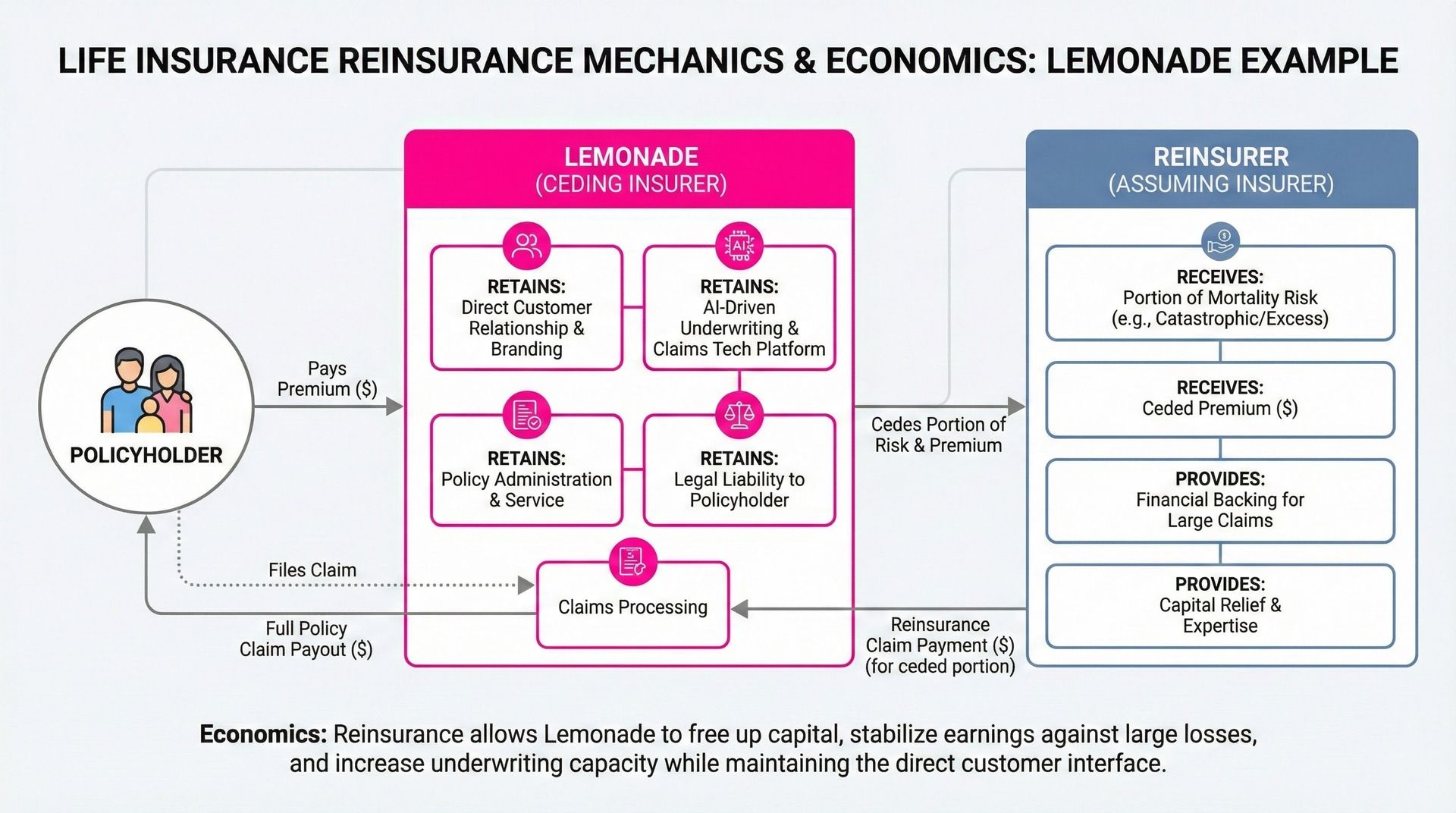
Reinsurance is insurance for insurance companies.
But the better way to think about it is this:
Lemonade keeps the customer, the pricing, and the brand.
A reinsurer takes on most of the financial risk, for a price.
Reinsurance lets Lemonade sell policies at scale without betting the company on worst-case outcomes.
How Lemonade structures the deal
A common structure looks like this:
Lemonade keeps 20% of the risk
A reinsurer takes 80% of the risk
So for my policy:
If I die, Lemonade pays $200,000
The reinsurer reimburses $800,000
That dramatically changes Lemonade’s risk profile. But the reinsurer doesn’t do this for free, obviously.
Where the reinsurer gets paid
That $60 monthly premium does not all stay with Lemonade.
A simplified version of the cash flow looks like this:
Customer pays: $720 per year
Lemonade sends: ~$520–$560 to the reinsurer
Lemonade keeps: ~$160–$200 (more on this split below, it’s important)
That retained portion is not random. It is designed to cover:
Distribution and marketing
Technology and servicing
Claims administration
Lemonade’s retained risk
A contribution margin
The reinsurer prices its share to:
Cover expected mortality claims
Cover its cost of capital
Earn a targeted return across a portfolio of millions of policies
Who is actually taking the risk?
Both parties are, but in very different ways.
Lemonade keeps:
Customer ownership
Brand trust
Pricing control
Renewal and cross-sell upside
Data and underwriting feedback loops
The reinsurer takes:
Mortality risk
Tail risk
Catastrophic downside
Long-duration balance-sheet exposure
I guess we can think about this as a devision of labor based on the strengths of each party.
Why do reinsurers say yes?
Reinsurers are not trying to:
Build apps
Acquire customers
Run marketing funnels
Manage UX or support
They are:
Balance-sheet specialists
Risk experts
Capital allocators
They do this because:
They pool millions of lives across many insurers
Death events become statistically predictable
Their capital is cheaper and better diversified
Risk that is existential for startups is “just another day at the office” at their scale
A win-win for both parties
Reinsurance allows Lemonade to:
Grow policies fast
Offer competitive pricing
Spend aggressively on product and marketing
Stay capital-light
Avoid blow-ups from rare events
This is how insurance becomes a scalable, software-like business instead of a slow-moving balance-sheet beast.
Reinsurance helps turn fixed promises into modular risk pieces that they can price and sell to the specialists.
Why Lemonade still makes money
Even with heavy reinsurance, Lemonade still has attractive economics because:
Most term policies never pay out
Many policies lapse early
Premiums are collected long before claims
Operating costs scale slower than policy count
In most cases, Lemonade keeps more than 20% of the premium to cover expenses and margin, even if it only retains ~20% of the risk. That mismatch is the whole point of the model from Lemonade’s standpoint.
This pattern exists everywhere
one surprising thing to me is that once you see this, you’ll spot it in other industries:
Banks sell loan risk but keep customers
SaaS companies offload infrastructure risk to cloud providers
Payment processors sell fraud guarantees
Factoring firms buy receivables at a discount
Same pattern every time:
Own the customer
Own pricing
Sell the tail risk
The operator takeaways
Three lessons worth stealing:
Separate customer ownership from risk ownership, when possible.
Price risk explicitly: If you cannot see where risk is priced, it’s probably leaking margin.
Design for long-term return on capital, not solely on gross margin.
Reinsurance is supply-chain optimization for risk.
I didn't really expect there to be many actionable takeaways here for people that aren't operating in insurance businesses. But the pattern of offloading risk to third parties while owning the customer relationship makes a ton of sense and is a mental model that I'm going to store away!
Let me know what you think of these types of reports. If you think I should just stick to company profiles, vote “Not for me” below! If you’d like more sprinkled in, vote “Loved it”.
How would you rate today’s report?Your rating helps me make these reports sharper and more useful — thanks for the quick tap! |
With that, I”ll see you tomorrow!
Nick